Units in the first test batch.
Case Study
Hadanuff!
A pursuit to resolve anger management in the funniest way possible.

Response target
< 30 ms
Experience promise
Instant fake destruction
First batch
5,000 units
Origin
Where the idea started
A comic concept became a real product challenge the moment the experience had to feel immediate, convincing, and strangely satisfying.
Paul, the inventor, came in with a grin and a complaint. His idea was wonderfully absurd: give people a way to vent frustration without breaking furniture, damaging a TV, or crossing a line.
He called it Hadanuff! — an electronic parody of rage itself. The appeal was emotional before it was technical: deliver a cathartic joke that felt vivid enough to trigger laughter, not repair bills.
Challenge
Make comedy behave like hardware
The brief sounded simple: pull the trigger of a mock pistol, point it at a TV, and instantly trigger a digital shatter effect on-screen.
But the whole illusion depended on timing. A delayed reaction would kill the joke. Every millisecond between the trigger and the payoff mattered, so the product had to feel cinematic without any actual destruction.
- No lag. The reaction had to feel immediate.
- No confusion. Audio and visuals needed to land together.
- No clutter. Everything had to fit inside a secure, hand-friendly enclosure.
Engineering
Building the response loop
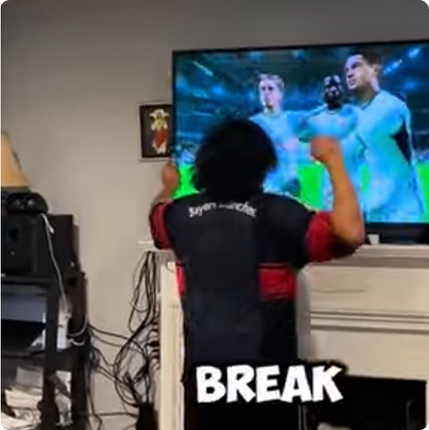
We embedded a radio transmitter inside a modified toy Glock and paired it with a TV receiver board through custom firmware. The moment the trigger clicked, the signal launched a fake shatter animation with synced sound effects.
The hard part was not the electronics alone. It was tuning humor into a reliable interaction design system.
- Optimize RF latency to stay under 30 milliseconds.
- Map trigger timing to the exact animation cue.
- Calibrate sound design so each fake blast felt intentional.
Prototype madness
Weeks of iteration, misfires, and pixelated chaos
The early builds were funny for the wrong reasons — which turned out to be useful signal.
- Some early versions misfired or responded too late, which instantly broke the illusion.
- Other builds triggered a delayed “explosion” or looped endlessly in pixelated inferno mode.
- After repeated tuning and testing, the team hit the instant-response threshold that made the experience feel absurdly satisfying.

Outcome
A joke product with real attention
The first test batch proved the concept had cultural pull, even if the commercial story was more nuanced.
Hadanuff! shipped its first test batch of 5,000 units. Social media responded with enthusiasm, and the project became a conversation piece because it translated frustration into something playful, engineered, and shareable.
Even when purchases lagged, the project still validated a bigger idea: success is not always measured only by sales. Sometimes the win is proving that emotional design, humor, and hardware can work together in a way people immediately understand.
Strong social engagement and curiosity.
Precision engineering can amplify emotion and humor.
Reflection
Designing for emotion, not just function
“We built something everyone wanted in secret,” Paul said, laughing.
For our team, the project became a lesson in the human side of product design. Laughter, frustration, and invention often share the same circuitry. Hadanuff! showed that even absurd ideas can demand serious systems thinking when the experience depends on timing, feedback, and emotional payoff.
It is a reminder that attractive products are not only polished on the outside. They also feel right in the split second when a user expects delight.
Want to see the original product community?
Visit the Hadanuff Facebook page to explore the social side of the project and how the concept was introduced publicly.